
The Logan County owner-of-record card
The assessor's Owner Name field is the tax roll's current-owner entry for Logan County. It finds an account fast. It is not a title report. Copy the fields below first, before comparing a deed or map. The record stays tied to the parcel. It does not follow a person with a similar name.
| Owner Name | Name shown on the assessment account; search the portal as LAST FIRST. |
|---|---|
| Mailing Address | Where tax correspondence is sent, which can differ from the property's location. |
| Situs / Physical Address | Address associated with the land or improvement. |
| Last sale or transfer clue | Available account information that can lead to the recorded instrument. |
| Deed Book/Page | Cross-reference to a recorded document in the County Clerk's records. |
Not every card shows all five fields. Sales history can be uneven too. Copy what is present, then carry the Account #, District/Map/Parcel, and Legal Description into another system to confirm the same Logan County parcel.
Where Logan County shows the current owner
Logan County's assessor offers a free property search by Parcel Address or Owner Name. The Owner Name field is the roll entry. The WV Property Viewer adds a map card. Alongside the owner it can show a physical address, an E-911 label, community, building details, values, delinquency status, flood context, and an assessment report. It is a related map view. It is not a certified deed copy. Names must be typed LAST NAME FIRST, with no comma. An LLC, trust, estate, or fiduciary needs its exact legal name from the deed or probate record. An entity-named card can still be the right account. It will not name the person behind the entity. The Logan County assessor search displays Owner Name, address, account, district, map/parcel, property type, legal description, and deed book and page fields on one form. Start there.
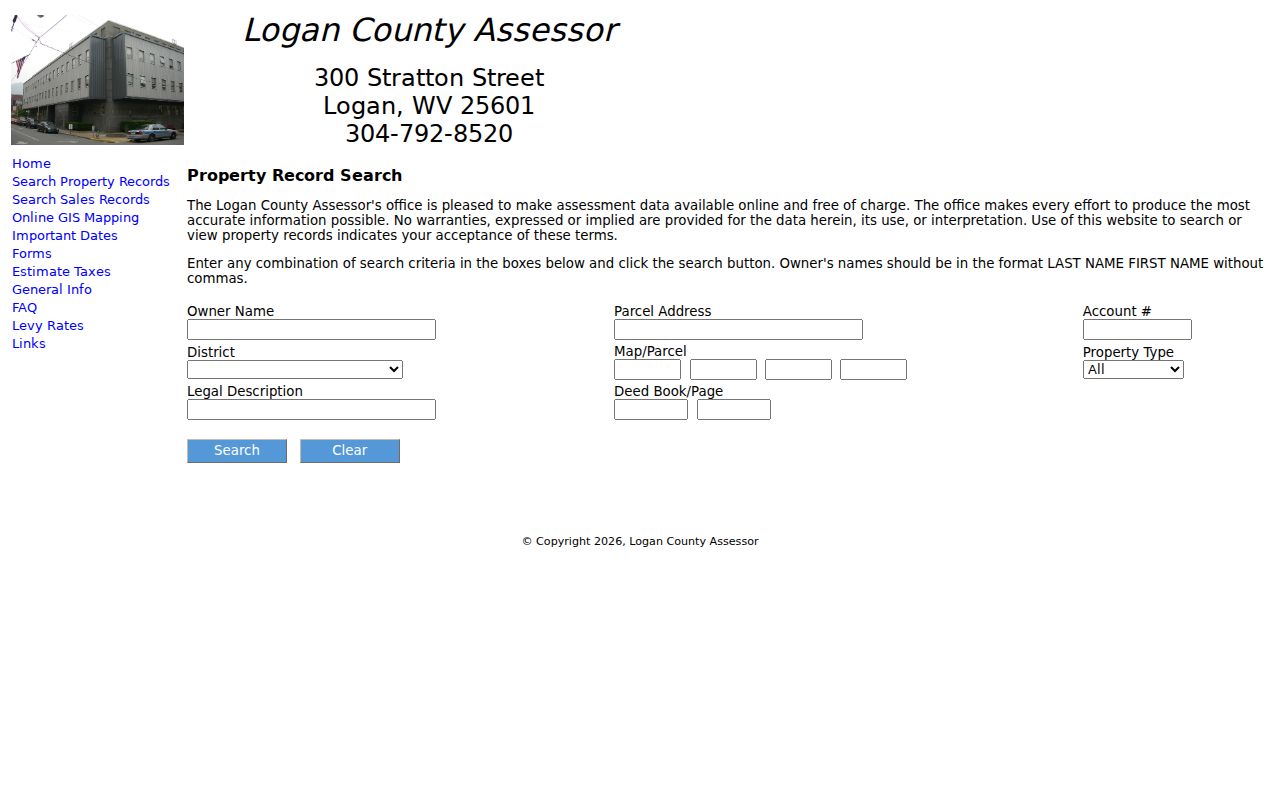
Begin a current-owner inquiry with the tax account. Then check the newest recorded instrument before trusting the name on it.
Compare the Logan County roll with the latest deed
The assessor's owner-of-record entry rarely changes the day a deed is recorded. Logan's assessment books run on an annual cycle. The newest deed carries its own filing date. The roll updates only when the account does. A mismatch can mean timing, an estate in progress, or a description problem. Check both sources. Never assume fraud from the gap alone. The county clerk's Cott portal indexes deeds, trust deeds, and liens from 1988 forward. Search it for the latest instrument. Compare the grantee, recording date, legal description, and book/page against the assessment account. If the online result misses what you need, ask the clerk for the record or the older index. The clerk can also confirm any image fee and how the search fields behave. For the full address-to-owner method, use the Logan County owner-finding route. This page stays on the present Owner Name.
Use Logan County deed book and page references
The assessor search takes Deed Book/Page in two paired inputs. This key works well when an address changed or the owner is unknown. Enter both pieces exactly as the record shows them. Then reuse it in the clerk's index or at the counter. Keep every digit and leading mark. Never trim a citation to fit another screen. Read the grantor and grantee lines carefully. The grantor gave up an interest. The grantee received it. A later deed, release, probate order, trustee sale, or correction can change what the first instrument alone suggests. Match the deed's land description to the tax parcel before calling it the owner record. For copies, give the exact book and page, instrument type, date, and parcel reference. The clerk's fee chart lists copy and certification charges, and the office can confirm the total for your pages.
Separate Logan County situs, mail, and E-911
The Owner Name card splits the mailing address from the physical, or situs, address. WV Property Viewer adds an E-911 address and a community label. Logan County's valleys and hollows complicate this. One parcel can carry one town on its mail, another label on the map, and a legal description tied to a tract or survey. Keep these clues separate in your notes. An out-of-county mailing address does not move the land. A Logan postal label does not put the parcel inside a city. ZIP lines and old annexations prove little either way. Compare the parcel with the current incorporated-place polygon. Keep the legal description intact. If two accounts seem to fit, weigh the full map/parcel, Account #, Deed Book/Page, and physical location together, because owner name alone is the weakest tie.
Logan's 1988 online boundary is not a title cutoff
Cott's coverage starts in 1988, according to the clerk. It reaches land deeds, trust deeds, and liens filed since then. That date is a convenience boundary. It is not a title cutoff. Older instruments still exist in Logan County. The online link simply stops there. So the assessor card may hold earlier history the portal never shows.
For pre-1988 transfers, turn to clerk indexes and deed books. WVU microfilm and State Archives finding aids help too. The Archives holds typed Logan deeds from 1836 through 1894 plus deed-index material through 1935. WVU lists grantor reels LOG 1-4, grantee reels LOG 5-8, and deed books LOG 9-19. It also holds historic land books, wills, surveys, contracts, and leases. Ask for exact reel and book numbers when you push a current-owner search backward.
Start from the latest deed reference. Record the grantor, grantee, tract, acreage, and any prior instrument cited. Those details bridge a modern tax roll to an older title chain.
Estate transfers can change Logan County names
A death can stall more than a family. The assessor card may still show the decedent long after. A later conveyance or an account update eventually replaces the name. The Logan County Clerk handles probate, wills, estates, guardianships, and notices to heirs. An estate transfer may surface in several forms. It could be an executor or administrator's deed. It might be an heir conveyance, a survivorship instrument, or a court order. Search both the former owner and the fiduciary or heir named in the later document.
WVU's finding aid points to Logan Will Books 8 and 9. It also lists LOG 188, a will index, plus appraisement and sale records. Remember that Cott's 1988-present statement covers deeds, trust deeds, and liens. It does not necessarily cover every probate document. Request the probate file at the clerk counter. Ask which copies are available.
Note: Never copy a Social Security number or protected medical data into a property note. An obituary may hint at family context, but it proves no transfer of title.
Request a certified Logan County owner record
An online result, screen print, or map card is not a certified copy. Another office may demand the real thing. Ask the clerk whether the deed or related instrument can be certified. Also ask what the current page charge runs. The local chart lists $1.50 for the first two copy pages. It adds $1.00 for each additional page and $1.00 for certification. The clerk should confirm the amount before any order.
Bring the County Clerk the document type and the parties. Include a book/page or document number, the recording period, and the legal description. The office sits at 300 Stratton Street, Room 102, Logan, WV 25601, phone 304-792-8600. Weekday hours run 8:30 a.m. to 4:30 p.m., closing noon to 1 p.m. for lunch. Call ahead for an older book or a probate file.
Note: A certified copy confirms what one instrument recorded, not that no later transfer exists or a full title opinion.
When a Logan County GIS owner card is stale
The parcel card in WV Property Viewer is dynamic. It links to assessment data and displays ownership and location fields. Yet the screen may lag behind a recently recorded change. Its owner may differ from the clerk's newest deed or the assessor account. If so, note the dates and references. Contact the custodian. A cached map or a saved link is never the final current record.
Confirm that the account, map/parcel, E-911, and legal description all describe the same land. A map settles location. The assessor keeps the roll. The clerk holds the recorded instruments. Prior-owner history lives in the deed chain. Follow it rather than treating a stale GIS field as a historic record.
The gap between a roll update and a deed recording is often just timing. Each source's own date explains more than any single owner label ever will.